


If you have ever picked up a t-shirt and felt like you were holding a paper towel, you already understand why GSM matters. You just did not have the word for it yet. This is that word, and everything it carries.

At Phantasmagorical we build clothing for people who notice things. The drape of a sleeve. The weight in the hand. The way a shirt either falls apart after a summer or quietly becomes the one you reach for first. Almost all of that comes down to one humble, unglamorous number: GSM. Here is what it means, why it matters, and how to use it to never buy a flimsy tee again.
What does GSM mean?
GSM stands for grams per square meter. It is simply the weight of one square meter of a fabric. A higher number means more cotton packed into the same space, which means a denser, more substantial garment. That is the whole secret. GSM is not marketing language. It is a measurement, and once you know it, you can feel a shirt with your eyes before you ever touch it.
What is 250 GSM in plain terms?
250 GSM means every square meter of the fabric weighs 250 grams. In the world of t-shirts, that is firmly in heavyweight territory. It has structure. It holds its shape. It drapes off the shoulder instead of clinging to it. When you pull a 250 GSM tee over your head, the weight is the first thing you register, and the softness is the second.
How heavy is 250 GSM compared to a normal t-shirt?
This is where the number earns its keep. A standard mass-market tee, the kind you find three-to-a-pack, usually sits around 150 to 180 GSM. A blank Hanes or Gildan lives right in that range. At 250 GSM, our Fluffy Vintage cotton is close to 40 percent heavier than that standard tee. You do not need a scale to feel the difference. It shows up in how the shirt hangs, how it survives the wash, and how long it stays the shape it was on day one.
250 GSM to oz: the quick conversion
If you think in ounces, divide the GSM number by roughly 34. So 250 GSM works out to about 7.4 oz per square yard. For reference, a typical lightweight tee is around 4.5 to 5.3 oz. Heavyweight begins where most shirts give up.
Is higher GSM always better?
Not exactly, and anyone who tells you otherwise is selling something. GSM is about purpose, not bragging rights. A breezy 150 GSM tee is the right tool for a heat wave. A 400 GSM hoodie is built for a cold desert night. The mistake the industry makes is treating featherweight as the default for everything, because thin fabric is cheaper to make and ship. The sweet spot for a tee you actually want to live in, one that feels substantial without feeling like a blanket, sits between about 240 and 300 GSM. That is exactly where we build.
What counts as a heavyweight t-shirt?
The term gets thrown around loosely, so here is an honest field guide to where the weights fall.
| Weight (GSM) | Category | What it feels like |
|---|---|---|
| 150 to 180 | Standard / lightweight | The three-pack basic. Thin, breathable, short-lived. |
| 200 to 220 | Midweight | A step up. Decent everyday tee, still drapes soft. |
| 240 to 280 | Heavyweight | Structure and presence. Boxy drape, built to last. Our Fluffy Vintage line at 250. |
| 300 to 360 | Ultra-heavyweight | Serious density. Sits like a light jacket. Our Ultra-Heavyweight line. |
| 400 and up | Outerwear weight | Hoodies, joggers, and pieces meant to hold heat. |
So when someone says heavyweight, they should mean roughly 240 GSM and above. If a brand calls a 190 GSM shirt heavyweight, gently raise an eyebrow.
Our fabric weights, from 250 to 420 GSM
We build each garment at the weight that suits its job:
- 250 GSM heavyweight tees across the Heavyweight T-Shirts and Fluffy Vintage lines.
- 270 to 275 GSM tanks in Heavyweight Tank Tops, heavier than many full t-shirts.
- 300 to 360 GSM specialty pieces in the Sacred Collection.
- 400 to 420 GSM for joggers and sweatpants and our heaviest hoodies.
Is 250 GSM cotton good, and will it be see-through?
250 GSM cotton is very good, and no, it is not see-through. At this density the fabric is fully opaque, which is more than you can say for most lightweight tees that reveal more than you intended under bright light. Good heavyweight cotton gives you coverage, structure, and a surface that takes a print beautifully and holds it. The trade is a little less airflow on the hottest days, which is a fair price for a shirt that outlives three of its lighter cousins.
What about hoodies, sweatpants, and joggers? How heavy should they be?
The same logic scales up with the garment. A hoodie or a pair of sweatpants has a different job than a tee. It needs to hold heat, survive being sat in, slept in, and stuffed into festival bags, and still keep its shape. That is why high GSM matters even more below the waist and over the shoulders. For fleece and loopback cotton, 300 GSM is a respectable floor, 350 is solid, and 400 and up is where you get that dense, armor-soft feel that cheap fleece can only imitate for about two washes. Our joggers and sweatpants are built at 420 GSM for exactly that reason, and the hoodies and sweatshirts follow the same philosophy. Between the everyday tee and outerwear weight, our Ultra-Heavyweight tees sit in the 300 to 360 GSM band, which is about as heavy as a t-shirt can go while still being a t-shirt.
The washes: snow wash, fluffy vintage, mineral wash, and sun fade
Weight is only half the story. The other half is finish. These are real garment treatments, not printed effects, so no two pieces come out exactly alike.
- Snow wash: a stone wash that leaves a static-like, frosted patina across the garment.
- Fluffy vintage wash: an enzyme tumble that breaks the fabric in, so it feels buttery and lived-in from the first wear.
- Mineral wash: minerals lift the color unevenly, leaving a mottled, weathered tone that pools darker in the seams and creases. Soft hand, heavy character.
- Sun fade: sun-faded color that reads like a shirt you have loved for a decade.
What is fluffy vintage washed cotton?
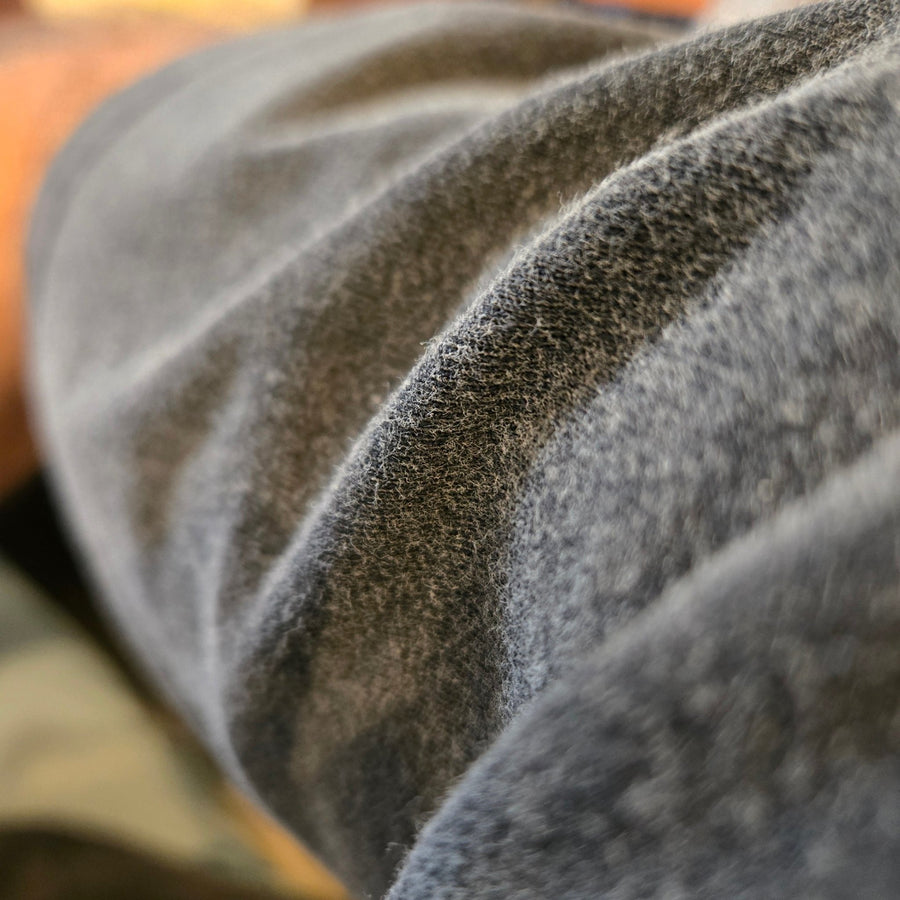
Our Fluffy Vintage cotton is 250 GSM ringspun cotton that has been brushed to raise a soft, plush surface, then garment washed to break it in before it ever reaches you. The result feels nothing like a stiff new tee. It has the lived-in softness of a shirt you have owned for years, and because the wash is built into the fabric, it only deepens with time. Most shirts get worse with every wash. This one gets better.
The vintage aesthetic is not a sticker we slap on. It is what happens when you start with heavy, honest cotton and let it age the way good things are supposed to.
Fits: boxy, oversized, relaxed, and drop shoulder
Weight and fit work together. Heavyweight cotton is what makes an oversized cut read as intentional instead of billowing, because the fabric has enough mass to hang rather than float. Most of our line runs relaxed with a drop shoulder for an easy, lived-in drape. Boxy and oversized cuts give a heavier streetwear silhouette, often with raw-edge or hand-frayed hems for broken-in detailing. Women's slim and cropped fits sit closer to the body.
How to care for heavyweight cotton so it lasts
Heavyweight cotton is forgiving, but a few small habits keep it at its best for years.
- Wash cold and inside out. This protects both the fibers and the print.
- Tumble dry low, or hang dry if you want to be gentle. High heat is the enemy of any cotton garment.
- Skip the bleach and the fabric softener. The wash already did the softening for you.
- Expect a little natural fading over time. With our vintage and mineral washes, that is the point, not a flaw.
Why we build at 250 GSM and up
Phantasmagorical started from a simple frustration. The clothing that carried the art we loved, the psychedelic, esoteric, sacred-geometry work of artists who deserved a wider canvas, was almost always printed on cheap, thin blanks that fell apart. The art deserved better. So we chose weight. We chose 250 GSM and above, original art from undiscovered artists, and a build made to outlast the trend cycle. Quality over everything, made for modern mystics who feel their clothes as much as they wear them.
Every piece is made to order, which means less waste and a garment made specifically for you. We build for longevity rather than the trend cycle, which is why we hold our quality and our pricing instead of racing to the bottom.
If you want to feel the difference rather than read about it, the easiest place to start is the Fluffy Vintage Heavyweight collection at 250 GSM, or browse the full range of heavyweight t-shirts. The Existential tee is a good first encounter with what 250 GSM actually feels like. And when you are ready to go heavier, the Ultra-Heavyweight line takes the same philosophy past 300 GSM.
Frequently asked questions
Is 250 GSM heavy enough for a t-shirt?
Yes. 250 GSM is a true heavyweight for a tee. It is around 40 percent heavier than a standard 150 to 180 GSM shirt, with real structure and a boxy, modern drape, while still being comfortable to wear all day.
What is the difference between 250 GSM and 180 GSM?
180 GSM is a standard lightweight tee that drapes thin and wears out faster. 250 GSM is denser, more opaque, holds its shape better, and lasts significantly longer. The 250 GSM fabric simply has more cotton in the same space.
Does higher GSM mean better quality?
Higher GSM means heavier and usually more durable, but quality also depends on the cotton, the knit, and the finish. For an everyday tee you want to keep, 240 to 300 GSM is the sweet spot. Beyond that you move into sweatshirt and outerwear territory.
What is considered high GSM for clothing?
It depends on the garment. For t-shirts, anything above about 240 GSM is heavyweight and above 300 is ultra-heavyweight. For hoodies and sweatpants, high GSM starts around 350, and 400 or more is premium outerwear weight.
What GSM should sweatpants and hoodies be?
Look for at least 300 GSM in fleece or loopback cotton. At 400 GSM and above, sweatpants and hoodies hold heat, keep their shape, and feel dense rather than flimsy. Our joggers are built at 420 GSM for that reason.
How do I convert GSM to ounces?
Divide the GSM number by about 34. So 250 GSM is roughly 7.4 oz per square yard, and 300 GSM is about 8.8 oz.
What is a mineral wash?
A mineral wash is a garment treatment where minerals lift the dye unevenly across the finished piece, leaving a mottled, weathered tone with darker settling in the seams and creases. It is done piece by piece, so every garment comes out slightly different.